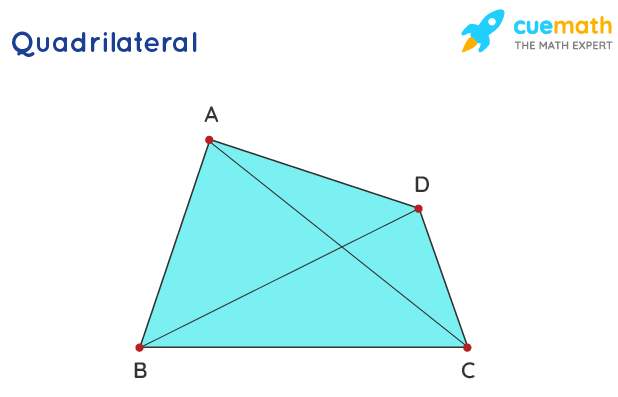
As per geometry, any closed shape that is formed by four points, three of which are non-collinear is known as the quadrilateral. Any shape is considered quadrilateral if it has 4 sides, 4 vertices, and 4 angles. All the sides of a quadrilateral may or may not be the same.
Types of Quadrilaterals and Properties
Despite having 4 sides, 4 angles, and 4 vertices, the measurements of the sides and angles of a quadrilateral differ from each other. One thing that must be kept in mind, is, that the sum of the interior angles of a quadrilateral must be 360 degrees. There 6 different types of quadrilaterals- square, rectangle, parallelogram, trapezium, rhombus, and kite. Some common properties of all the quadrilaterals are as follows:
- Every quadrilateral has 4 sides.
- It has 4 vertices.
- It also has 4 interior angles.
- A quadrilateral has two diagonals.
- The total sum of all the angles of a quadrilateral is 360 degrees.
Square
A shape or a quadrilateral that has 4 equal sides and 4 right angles is known as a square.
If we consider a circle named ABCD, then,
- Its 4 equal sides, AB=BC=CD=AD
- 4 right angles, ∠A=∠B=∠C=∠D=90°
- Its parallel sides, AB ∥ DC and AD ∥ BC
- 2 diagonals that are equal to each other, AC=BD
- The two diagonals bisect each other
- The diagonals are perpendicular to each other as well, AC⊥BD.
Rectangle
A quadrilateral that has two pairs of equal and parallel opposite sides and four right angles is known as a rectangle.
Let us assume a rectangle named, PQRS.
- PQRS has two pairs of parallel sides, PS ∥ QR and PQ ∥ SR
- It has 4 right angles, ∠P = ∠Q = ∠R = ∠S = 90°
- The opposite sides are of the same length, PQ=SR, and PS=QR
- It has two diagonals of equal length in measure, PR=QS
- The two diagonals bisect each other.
Parallelogram
A shape whose both the pairs of opposite sides are parallel is known as a parallelogram.
Let us take an example, EFGH is the name of a parallelogram,
- EFGH has two pairs of parallel sides, i.e., EF ∥ HG and EH ∥ FG
- It has opposite sides of the same lengths, EF=HG and EH=FG
- The opposite angles of a parallelogram are equal, ∠E=∠G and ∠F=∠H
- It also has two diagonals that bisect each other.
Trapezium
In a trapezium, one pair of the opposite sides are equal. The sides parallel to each other are known as bases, and the sides that are not parallel are called the legs.
If we see that two opposite sides which are not parallel to each other are of the same length, then it is known as an isosceles trapezium.
Rhombus
A quadrilateral that has four sides of the same length is known as a rhombus.
Let us assume a rhombus named MNOP,
- It has two pairs of parallel sides, MN ∥ PO and MP ∥ NO
- It has four equal sides, MN=NO=OP=PM
- Its opposite angles are the same, ∠M=∠O and ∠N=∠P
- It has two diagonals that are perpendicular to each other, MO⊥PN
- The diagonals bisect each other.
Area of Quadrilateral
The space or the region enclosed within the sides of a quadrilateral is known as the area of that quadrilateral. The value of the area is expressed in square units, like m2, in2, cm2, etc. There are various ways to find out the area of a quadrilateral. We can identify the type of the quadrilateral based on its sides and angles and measure the area accordingly. We can even find out the area by dividing the quadrilateral into two triangles or by using the Bretschneider′s formula.
Cuemath classes are different from the other online classes, they conduct the lectures in an attractive and fun way. Book a free session now.