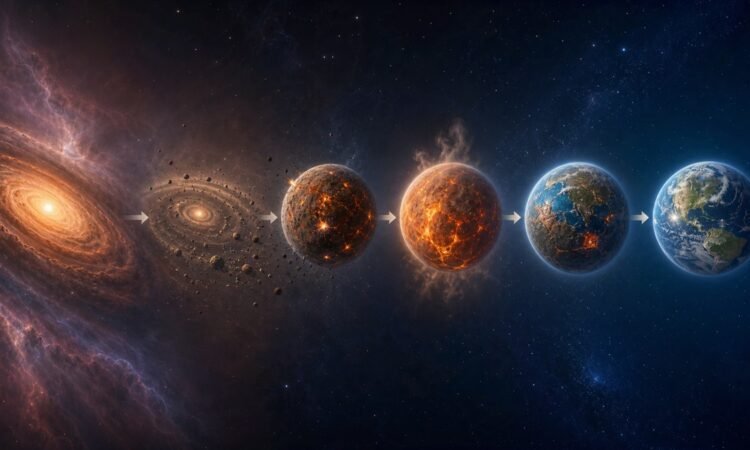
The NCERT Class 11 Geography chapter on the origin and evolution of Earth connects three scales of history: the expanding universe, the formation of stars and planets, and the transformation of a hot young Earth into a layered planet with oceans, an atmosphere and life. The easiest way to revise it is to learn that sequence first, then attach the terms and dates to the correct stage.
These notes follow the official NCERT Chapter 2 PDF for the 2026-27 reprint and use current NASA Earth facts to clarify modern scientific context. They summarize the chapter rather than replacing the textbook diagrams, exercises or teacher guidance.
Chapter at a glance
- Early thinkers proposed hypotheses about how Earth and the planets formed.
- The Big Bang model describes the expansion and early development of the universe.
- Uneven matter collected under gravity, forming galaxies, stars and nebulae.
- A rotating disk of gas and dust around the young Sun produced planetesimals.
- Planetesimals collided and accreted into planets, including Earth.
- Young Earth differentiated into the crust, mantle and core.
- Degassing, cooling and condensation helped form the atmosphere and oceans.
- Photosynthesis eventually increased atmospheric oxygen, while life left a fossil record.
Early theories of Earth’s origin
The chapter begins with the nebular hypothesis associated with Immanuel Kant and later revised by Laplace. In this early view, planets formed from material linked to a young, slowly rotating Sun. In the twentieth century, Otto Schmidt and Carl Weizsacker proposed revised versions involving a solar nebula made mainly of hydrogen and helium with dust. Friction and collisions flattened material into a disk, and planets formed by accretion.
These ideas matter because science changes as observations improve. An older hypothesis may introduce a useful mechanism even when later evidence changes its details. Instruments such as astronomy telescopes and analysis of meteorites let researchers test models that earlier thinkers could only reason about indirectly.
The Big Bang and the expanding universe
NCERT presents the Big Bang theory as the most widely accepted explanation for the origin and expansion of the universe. Edwin Hubble’s observations showed that galaxies are moving farther apart. The familiar balloon example helps visualize increasing distance, but it has a limitation: dots drawn on a balloon also stretch, while galaxies themselves are not expanding in the same way.
The chapter gives an age of about 13.7 billion years for the Big Bang. Modern estimates are often stated near 13.8 billion years; for an NCERT examination, use the figure and wording in the assigned edition unless the teacher asks for an updated value. The core idea is that the universe began in an extremely hot, dense state and expanded. Energy and matter developed as it cooled, and atoms formed after the temperature fell enough.
From galaxies to stars
Matter and energy were not distributed evenly in the early universe. Small density differences produced differences in gravitational pull. Matter collected into enormous clouds, which became the foundations of galaxies. Within a galaxy, hydrogen gas accumulated in nebulae. Denser local clumps contracted further and eventually formed stars.
Researchers now handle enormous observational data sets to compare models with evidence. DeepTechy’s guide to data science in space exploration explains why images, spectra and measurements need careful processing before they become scientific conclusions.
How planets formed
NCERT divides planet formation into three stages. First, gravity creates a dense core inside a gas cloud, with a rotating disk of gas and dust around it. Second, material in the disk condenses into small rounded bodies called planetesimals. Collisions and gravity make some of these bodies stick together and grow. Third, many planetesimals accrete into fewer, larger planetary bodies.
NASA describes the solar system as forming about 4.6 billion years ago from a dense cloud of gas and dust. Earth formed about 4.5 billion years ago as gravity gathered material in the young solar system. The numbers differ slightly depending on rounding and what starting event is being measured. NCERT’s exercise asks students to recognize Earth’s age as about 4.6 billion years.
Evolution of the young Earth
Early Earth was hot, rocky and barren, with an atmosphere unlike today’s. Heat came from collisions, compression and radioactive decay. The planet was partly molten, allowing materials to separate according to density. Heavy substances such as iron moved inward, while lighter materials rose toward the surface. This separation is called differentiation.
Differentiation created a layered structure: crust, mantle, outer core and inner core. Cooling allowed the outer surface to solidify into crust. A giant impact early in Earth’s history is the leading explanation for the Moon’s formation and would have reheated the planet. NASA notes that evidence supports a major collision near the beginning of the solar system, although details remain an active research topic.
Evolution of the atmosphere and hydrosphere
NCERT describes three broad stages in the atmosphere’s development. First, the light primordial gases hydrogen and helium were lost, partly under the effect of solar wind. Second, gases and water vapor escaped from Earth’s interior through degassing and volcanic activity. The early atmosphere included water vapor, nitrogen, carbon dioxide, methane and ammonia, with very little free oxygen.
As Earth cooled, water vapor condensed. Carbon dioxide dissolved in rainwater, further cooling supported more condensation, and water collected in surface depressions to form oceans. The chapter states that oceans formed within roughly 500 million years of Earth’s formation and were about 4 billion years old.
The Sun remains the main energy source driving Earth’s surface systems. A separate explanation of solar power basics can help distinguish the modern use of sunlight from the much older process of planetary formation.
Oxygen and the origin of life
Early free oxygen was scarce. Photosynthetic organisms in the oceans began releasing oxygen. At first, oxygen reacted with materials in the ocean; later it accumulated in the atmosphere. NCERT places substantial atmospheric oxygen after a long period of oceanic photosynthesis.
The chapter treats the origin of life cautiously as a process in which chemical reactions produced increasingly complex organic molecules and self-replicating systems. Fossils preserve evidence of organisms that lived at different times. NCERT states that life may have begun evolving around 3.8 billion years ago, while emphasizing microscopic early forms rather than modern plants or animals.
Important terms
- Nebula: a vast cloud of gas and dust.
- Accretion: growth through collisions and the accumulation of material.
- Planetesimal: a small early body that can combine into a planet.
- Differentiation: separation of planetary materials according to density.
- Degassing: release of gases from Earth’s interior.
- Hydrosphere: Earth’s water in oceans, ice, groundwater and the atmosphere.
- Light-year: a unit of distance, not time.
Common exam mistakes
Do not describe the Big Bang as an explosion into empty space; the key classroom idea is expansion of the universe. Do not confuse a light-year with a year. Keep accretion, differentiation and degassing in the right order. Avoid saying that oceans or an oxygen-rich atmosphere appeared immediately. Finally, distinguish the origin of the universe from the later formation of the solar system and Earth.
How to write a 150-word answer
Begin with Earth forming by accretion in the young solar system about 4.6 billion years ago. Then explain that heat left the planet partly molten, so dense material sank and lighter material rose during differentiation. State that cooling formed the crust, while volcanic degassing supplied water vapor and gases. Continued cooling allowed condensation and ocean formation. End by explaining that photosynthetic life gradually added oxygen to the oceans and atmosphere. This order answers the question as a process, uses the chapter’s key terms, and avoids mixing the origin of the universe with the later evolution of Earth.
Scientific observation also depends on precise instruments and navigation. DeepTechy’s explanation of an optical guidance system provides a technology example of how sensors translate light into usable positional information.
Frequently asked questions
How old is Earth?
NCERT uses about 4.6 billion years in its exercise. NASA commonly describes Earth as forming about 4.5 billion years ago; the difference is largely rounding and context.
What is the nebular hypothesis?
It is the idea that the Sun and planets developed from rotating material in a nebula. Modern models add evidence about disks, accretion and planetary chemistry.
What is a planetesimal?
It is one of the many small solid bodies that formed in the young solar disk and combined through collisions and gravity.
Why did Earth develop layers?
When early Earth was hot and partly molten, denser material such as iron sank while lighter material rose. This differentiation produced the core, mantle and crust.
How did the first atmosphere form?
The earliest light gases were largely lost. Volcanic degassing then released water vapor and other gases, while life later changed atmospheric composition through photosynthesis.
How did oceans form?
As the planet cooled, atmospheric water vapor condensed as rain and collected in surface depressions over a long period.
When did life begin?
NCERT discusses evidence consistent with life beginning to evolve around 3.8 billion years ago. The exact pathway from chemistry to life remains a major scientific question.
What should I revise first?
Memorize the sequence: universe, galaxies and stars, solar disk, planetesimals, accretion, differentiation, degassing, oceans, photosynthesis and oxygen.
Revision takeaway
The chapter is a connected story rather than a list of dates. Gravity organizes matter, accretion builds planets, heat permits differentiation, cooling supports crust and oceans, and living organisms gradually alter the atmosphere. Once that causal chain is clear, the terms and time markers become much easier to remember.