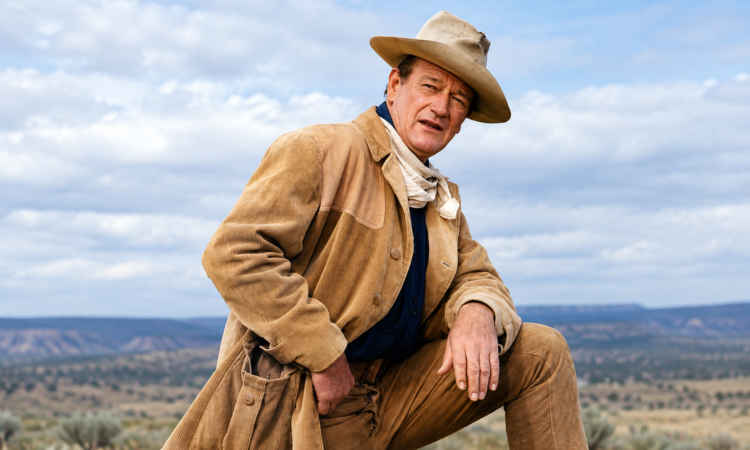
Few actors are as closely associated with American cinema as John Wayne. Over a career spanning roughly five decades, Wayne appeared in an extraordinary number of films, moving from early low-budget Westerns to major Hollywood productions and eventually to some of the most recognizable movies of the 20th century. The official John Wayne site describes his career as encompassing 175 films, with his final movie, The Shootist, released in 1976.
For someone searching for John Wayne movies, however, the sheer size of his filmography can be overwhelming. Where should you begin? Which films are Westerns, which are war movies, and which show Wayne at his most versatile? And if you want to watch his movies in order, should you start with his earliest appearances or his first major starring roles?
This guide breaks down John Wayne’s movie career chronologically, highlights his most important films, explains his collaborations with directors and co-stars, and provides a practical starting point for anyone discovering “The Duke” for the first time.
How Many John Wayne Movies Are There?
John Wayne appeared in approximately 175 films during his career, according to John Wayne Enterprises. His screen career began with early appearances in the 1920s and continued until his final film in 1976.
That number includes more than the famous Westerns for which he is best remembered.
Wayne worked across several genres, including:
- Westerns
- War films
- Adventure movies
- Historical dramas
- Romantic comedies
- Crime films
- Action movies
- Military dramas
His enormous filmography also reflects the different stages of Hollywood during his lifetime.
John Wayne’s First Major Starring Film
Wayne’s first major starring role came in The Big Trail (1930), directed by Raoul Walsh. He played Breck Coleman, a role that introduced audiences to the young actor who would eventually become one of Hollywood’s biggest stars.
Interestingly, Wayne was not originally a major star when the movie was made. His career developed through years of work in smaller productions before Stagecoach dramatically changed his position in Hollywood.
John Wayne Movies in Order: Key Films by Year
Because Wayne made so many movies, listing every screen appearance in a single article would make the guide difficult to use. The following chronological list focuses on major and historically significant films that help explain the development of his career.
1930s
1930 — The Big Trail
Wayne’s first major starring role and an important early step in his career.
1933 — Riders of Destiny
One of his early Westerns and an example of the singing-cowboy cycle popular at the time.
1939 — Stagecoach
The film that transformed Wayne into a major star. His portrayal of the Ringo Kid became one of the defining performances of his early career.
Stagecoach is particularly important because it began the long creative relationship between Wayne and director John Ford that would produce several landmark movies.
1940s
The 1940s saw Wayne move increasingly into major productions.
Important titles include:
- The Long Voyage Home (1940)
- The Fighting Seabees (1944)
- They Were Expendable (1945)
- Back to Bataan (1945)
- Fort Apache (1948)
- Red River (1948)
- Sands of Iwo Jima (1949)
Wayne’s wartime movies became an important part of his screen identity. His official biography notes that he made numerous films depicting military characters during the World War II era, including Flying Tigers, The Fighting Seabees, They Were Expendable, Back to Bataan and Sands of Iwo Jima.
Red River (1948)
Directed by Howard Hawks, Red River gave Wayne one of his more complicated dramatic roles as Thomas Dunson.
It is particularly useful for viewers who want to see Wayne outside the straightforward heroic persona associated with some of his later Westerns.
Sands of Iwo Jima (1949)
This military drama became another important Wayne performance. He received an Academy Award nomination for the role, according to John Wayne Enterprises.
1950s: The Duke at His Peak
The 1950s were an especially important period in Wayne’s career.
Some major titles include:
- Rio Grande (1950)
- Flying Leathernecks (1951)
- The Quiet Man (1952)
- Hondo (1953)
- Blood Alley (1955)
- The Searchers (1956)
- The Wings of Eagles (1957)
- The Barbarian and the Geisha (1958)
- Rio Bravo (1959)
- The Horse Soldiers (1959)
John Wayne Enterprises notes that Wayne remained near the top of the box-office rankings throughout much of the decade and frequently completed several films in a single year.
The Quiet Man (1952)
This John Ford film is particularly useful for anyone who assumes every John Wayne movie is a Western.
Wayne plays Sean Thornton, an American returning to Ireland. Maureen O’Hara plays Mary Kate Danaher, beginning one of the most recognizable screen partnerships in Wayne’s career.
The Searchers (1956)
The Searchers is one of the most discussed films in Wayne’s career.
Wayne plays Ethan Edwards, a Civil War veteran searching for his kidnapped niece. The film reunited Wayne with John Ford and was filmed extensively around Monument Valley.
The official John Wayne site describes the movie as one of Ford’s most revered films and a landmark of their collaboration.
Rio Bravo (1959)
Rio Bravo paired Wayne with director Howard Hawks, Dean Martin, Ricky Nelson, Angie Dickinson and Walter Brennan.
Wayne plays Sheriff John T. Chance, who must defend a small Texas town while waiting for assistance.
The film’s central setup—characters with limited resources defending themselves against a larger threat—became enormously influential in later action and Western filmmaking.
1960s: Bigger Productions and New Directions
Wayne remained extremely productive during the 1960s.
Important films include:
- The Alamo (1960)
- The Man Who Shot Liberty Valance (1962)
- Hatari! (1962)
- Donovan’s Reef (1963)
- McLintock! (1963)
- In Harm’s Way (1965)
- The Sons of Katie Elder (1965)
- El Dorado (1966)
- The War Wagon (1967)
- The Green Berets (1968)
- True Grit (1969)
The Alamo (1960)
The Alamo was particularly significant because Wayne was not only the star. He also produced and directed the film.
The production received seven Academy Award nominations, including Best Picture, according to John Wayne Enterprises.
Hatari! (1962)
Directed by Howard Hawks, Hatari! moved Wayne away from the traditional Western setting.
The movie follows a group of professional animal catchers working in Africa. The production was filmed partly in what is now Tanzania’s Arusha region, giving audiences spectacular location footage.
The Man Who Shot Liberty Valance (1962)
This film reunited Wayne with John Ford and featured James Stewart.
It is one of the most notable examples of Wayne working in a story that questions the difference between historical truth and the legends people create around famous figures.
McLintock! (1963)
Wayne and Maureen O’Hara reunited for this Western comedy.
Their chemistry became one of the recurring attractions of their collaborations, and they would work together several times throughout Wayne’s career.
True Grit (1969)
For many viewers, True Grit is essential among all John Wayne movies.
Wayne plays U.S. Marshal Rooster Cogburn, a rough, aging lawman recruited to help track down a killer.
The performance earned Wayne the Academy Award for Best Actor, his only competitive acting Oscar. The official John Wayne site identifies the role as one of the major achievements of his career.
It is also an excellent movie to watch if you want to see Wayne playing a character who is less conventionally polished than some of his earlier heroes.
1970s: John Wayne’s Final Movies
Wayne continued working during the final decade of his life.
Notable films include:
- Chisum (1970)
- Rio Lobo (1970)
- Big Jake (1971)
- The Cowboys (1972)
- The Train Robbers (1973)
- Cahill U.S. Marshal (1973)
- McQ (1974)
- Brannigan (1975)
- Rooster Cogburn (1975)
- The Shootist (1976)
His official career history notes that Wayne made nearly a dozen films during the 1970s despite being in his 60s.
The Cowboys (1972)
Wayne plays a rancher who is forced to rely on a group of inexperienced boys when adult workers become unavailable.
It is one of his more memorable later Westerns and shows a different relationship between Wayne’s character and younger performers.
Big Jake (1971)
Big Jake brought Wayne together with several familiar faces and continued his long association with the Western genre.
It was also one of his collaborations with Maureen O’Hara.
The Shootist (1976)
The Shootist was John Wayne’s final film.
He plays J.B. Books, an aging gunfighter confronting the end of his life.
The casting carries an unusual historical weight because Wayne himself was nearing the end of his career. The movie also reunited him with actors including Jimmy Stewart and Lauren Bacall.
Best-Known John Wayne Movies to Start With
Rather than treating “best” as an objective ranking, a better way to choose a John Wayne movie is to match the film to the kind of story you enjoy.
For classic Westerns
Try:
- Stagecoach
- Red River
- The Searchers
- Rio Bravo
- The Man Who Shot Liberty Valance
- True Grit
For military movies
Try:
- They Were Expendable
- Sands of Iwo Jima
- Flying Leathernecks
- In Harm’s Way
For comedy and lighter entertainment
Try:
- McLintock!
- Donovan’s Reef
- Hatari!
For a later-career performance
Start with:
- True Grit
- The Cowboys
- Big Jake
- The Shootist
John Wayne and Dean Martin Movies
One popular search is “Dean Martin and John Wayne movies.”
The two actors appeared together in several important films, most notably:
- Rio Bravo (1959)
- The Sons of Katie Elder (1965)
- Rio Lobo (1970)
Their most famous collaboration is probably Rio Bravo, where Martin plays Dude, a former deputy struggling with alcoholism while helping Wayne’s sheriff defend the town.
The contrast between Wayne’s controlled lawman and Martin’s troubled character gives the film much of its dramatic tension.
John Wayne and Maureen O’Hara Movies
Wayne and Maureen O’Hara also formed one of Hollywood’s best-known recurring screen partnerships.
Their films together included:
- Rio Grande (1950)
- The Quiet Man (1952)
- The Wings of Eagles (1957)
- McLintock! (1963)
- Big Jake (1971)
John Wayne Enterprises specifically identifies these five collaborations and describes the pair as a memorable screen partnership.
What Makes John Wayne’s Filmography Unusual?
The interesting thing about John Wayne movies is not simply the number of films he made.
It is the range within that number.
A viewer can watch Stagecoach to see an early star-making performance, Red River for a darker dramatic role, The Quiet Man for romance and comedy, Hatari! for adventure, True Grit for an Oscar-winning performance, and The Shootist for a late-career drama.
Another easily overlooked point is how often Wayne worked with the same creative partners. His relationship with John Ford stretched across decades, while Howard Hawks directed him in several important films.
A third insight is that watching his films chronologically reveals how the image of John Wayne changed. The young actor of the 1930s gradually became the established star of the 1950s, then increasingly played older, more complicated characters in the 1960s and 1970s.
How to Watch John Wayne Movies in Order
If you want to understand Wayne’s career rather than simply watch individual popular titles, a chronological approach works well.
A practical starting sequence would be:
- The Big Trail (1930)
- Stagecoach (1939)
- Red River (1948)
- Rio Grande (1950)
- The Quiet Man (1952)
- The Searchers (1956)
- Rio Bravo (1959)
- The Man Who Shot Liberty Valance (1962)
- The Sons of Katie Elder (1965)
- True Grit (1969)
- The Cowboys (1972)
- Big Jake (1971)
- Rooster Cogburn (1975)
- The Shootist (1976)
This isn’t a complete 175-film chronology; it is a practical viewing path through major stages of his career.
Frequently Asked Questions
How many movies did John Wayne make?
John Wayne Enterprises lists 175 films across his career. His screen work began with appearances in the 1920s and continued through his final film, The Shootist, in 1976.
What are the most famous John Wayne movies?
Frequently discussed titles include Stagecoach, Red River, The Searchers, Rio Bravo, The Man Who Shot Liberty Valance, True Grit, The Quiet Man and The Shootist. These films represent different periods and genres rather than a single style of Wayne performance.
What was John Wayne’s first major movie?
The Big Trail (1930) was Wayne’s first major starring role. He played Breck Coleman under director Raoul Walsh, several years before Stagecoach made him a major Hollywood star.
What was John Wayne’s last movie?
John Wayne’s final movie was The Shootist, released in 1976. He played J.B. Books, an aging gunfighter facing the final stage of his life.
Which John Wayne movie won him an Oscar?
Wayne won the Academy Award for Best Actor for his performance as Rooster Cogburn in True Grit (1969). The role remains one of the defining performances of his career.
Did John Wayne make movies with Dean Martin?
Yes. Wayne and Dean Martin appeared together in films including Rio Bravo, The Sons of Katie Elder and Rio Lobo. Their collaboration in Rio Bravo is particularly well known.
Conclusion
The enormous number of John Wayne movies can make his filmography seem difficult to approach, but it becomes much easier when viewed by era and genre.
Start with Stagecoach to understand his breakthrough, move to Red River and The Searchers for two very different Western performances, watch Rio Bravo for his famous collaboration with Dean Martin, and explore The Quiet Man or Hatari! to see him outside the traditional Western.
For his later career, True Grit and The Shootist are especially useful because they show how Wayne’s screen persona evolved as he grew older.
His career ultimately covered about 50 years and approximately 175 films. From the young actor in The Big Trail to his final performance in The Shootist, the filmography provides a remarkable record of how one performer became permanently associated with the Western while still working across war, adventure, comedy and drama.