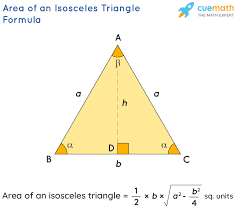
An isosceles triangle is a unique type of triangle where two sides are of equal length and the angles opposite these sides are equal. Calculating the area of an isosceles triangle is a fundamental geometric process, widely applicable in various fields like architecture, design, and mathematics. Understanding the area calculation formula is essential for anyone looking to solve geometry problems effectively.
What is an Isosceles Triangle?
An isosceles triangle is a type of triangle where at least two sides have equal lengths. This equality makes it symmetrical, with two equal angles opposite these sides. The base is the side that is not equal to the other two sides. The area of an isosceles triangle can be determined using basic formulas, provided the height or the angles of the triangle are known.
Formula for Calculating the Area
The area of an isosceles triangle can be calculated using the basic formula:Area=12×base×height\text{Area} = \frac{1}{2} \times \text{base} \times \text{height}Area=21×base×height
Here, the base is the unequal side, and the height is the perpendicular distance from the base to the opposite vertex. This formula is the most straightforward and widely used method for finding the area of an isosceles triangle when the height is given.
Deriving the Height
If the height is not provided, it can be derived using the Pythagorean theorem. Consider an isosceles triangle with two equal sides (a), a base (b), and a height (h). By dividing the triangle into two equal halves, we form two right-angled triangles. Using the Pythagorean theorem:h=a2−(b2)2h = \sqrt{a^2 – \left(\frac{b}{2}\right)^2}h=a2−(2b)2
Once the height is calculated, substitute it into the area formula to find the area of an isosceles triangle.
Special Cases of the Isosceles Triangle
When Angles are Known
If the angles of the triangle are known, trigonometry can be used to calculate the area of an isosceles triangle. The formula in this case is:Area=12×a2×sin(angle)\text{Area} = \frac{1}{2} \times a^2 \times \sin(\text{angle})Area=21×a2×sin(angle)
Here, aaa is the length of the equal sides, and angle\text{angle}angle is the angle between them.
When All Sides are Known
If all three sides are known, Heron’s formula can be applied to calculate the area of an isosceles triangle. The steps are:
- Find the semi-perimeter sss:s=a+a+b2s = \frac{a + a + b}{2}s=2a+a+b
- Apply Heron’s formula:Area=s×(s−a)×(s−a)×(s−b)\text{Area} = \sqrt{s \times (s – a) \times (s – a) \times (s – b)}Area=s×(s−a)×(s−a)×(s−b)
This method is versatile and does not require the height or angles.
Real-Life Applications
The area of an isosceles triangle is not just a mathematical concept but has practical implications in various fields. Architects and engineers often use it to calculate the space within triangular sections of buildings or bridges. Designers use it in creating symmetrical patterns, while surveyors apply it in land measurement and mapping.
Importance of Understanding the Concept
Understanding how to calculate the area of an isosceles triangle is crucial for solving geometric problems. Whether it’s for academic purposes, professional work, or real-life applications, mastering this skill enables better problem-solving and analytical thinking.
Challenges in Calculating the Area
One common challenge is determining the height of the triangle when it is not directly given. In such cases, using the Pythagorean theorem or trigonometric identities becomes necessary. Another challenge arises when dealing with non-integer values, requiring precise calculations for accurate results.
Tips for Accurate Calculations
- Always double-check measurements of the sides and angles.
- Use a calculator for complex trigonometric or square root computations.
- If working with diagrams, ensure the triangle is drawn to scale for better visualization.
Conclusion
The area of an isosceles triangle is a foundational concept in geometry, providing insights into the properties of symmetrical shapes. With multiple methods available for calculation, including the height-based formula, trigonometry, and Heron’s formula, understanding this topic is essential for tackling a wide range of mathematical and real-world problems. By mastering the calculations, one can confidently approach both academic and professional challenges involving isosceles triangles.