
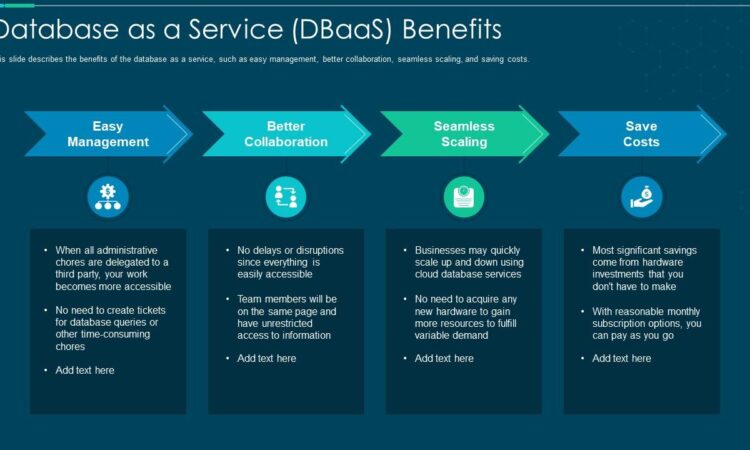
The most obvious advantages of the database-as-a-service (DBaaS) are that it is cost-effective and efficient, enables on-demand scalability, and has integrated management tools. However, other advantages may not be immediately apparent. The following are some of the benefits of a database as a service. DBaaS is becoming popular among businesses looking for flexible cloud-based software solutions.
DBaaS is a cloud-based software service.
DBaaS is a cloud-based software service that provides access to database resources. It is typically scalable and enables failover, and is highly reliable. It eliminates manual scaling and management and enables customers to respond quickly to changing circumstances. Additionally, DBaaS services are often highly flexible, meaning users can scale their data as needed.
DBaaS can be defined as a case-specific cloud service model that enables the management of a database without the need for physical hardware. This service provides administrative capabilities to the database and other underlying technologies. It can be a stand-alone SaaS or part of a complete IaaS stack. Users can manage a database instance through a web-based management dashboard or API.
DBaaS is significantly cheaper than other Cloud-based services. Businesses can invest in what they need instead of massive database infrastructure. Companies no longer need to worry about power bills, staffing, or maintenance. Additionally, DBaaS is easy to scale. It requires less time and money to scale out to multiple clouds. The provider handles the hardware and software for you, making it easier to use less physical space and reduce operating costs.
It is efficient and cost-effective.
A database as a service (DBaaS) solution is an effective way to scale databases. It allows businesses to leverage cloud-based technology while freeing IT personnel to focus on other tasks. DBaaS is extremely scalable, with the ability to easily add more computing and storage capacity to meet your organization’s needs. Whether you are building a large-scale app or a simple database for your personal use, a database as a service is a smart move.
The process of deploying a database is not efficient. It is because the DBA has a wide range of duties. These duties include configuration, backup, and recovery. Many of these tasks are repetitive and mundane, so automating them is a good move. It will free up a developer’s time and allow the database to continue running as intended. Moreover, DBaaS is cost-effective because it is based on a subscription model.
It allows for on-demand scalability.
The demand for scalability continues to grow, and cloud computing is a great way to meet those needs. Cloud computing can help ensure that your company has the right resources available at all times and that your applications and infrastructure are always up-to-date. As a result, you can scale on-demand without the worry of investing huge sums of money upfront or incurring recurring costs that may be excessive. As a result, many companies have already switched to the cloud to serve their customers better.
With on-demand scalability, you can scale up or down your infrastructure whenever needed without worrying about increasing costs or compromising performance. Cloud computing lets you add or remove resources as needed and can eliminate outdated hardware. The best part about cloud computing is that you can scale up or down without any downtime, and there’s no need to invest in expensive hardware and software. Ultimately, you’ll only pay for the resources you need when you need them.
It provides integrated management tools.
Database-as-a-service (DBaaS) is a cloud-based software service that delivers a database with administrative capabilities. It handles the maintenance and administration of the database and its underlying technologies. DBaaS can be a front-end SaaS service or part of a full IaaS stack. A database is a central repository for structured data. Traditionally, organizations have installed and managed the database server themselves.
DBMSs can provide centralized access to a database through a unified interface. Users can easily modify the logical and physical schema of a database without disrupting its operation. It simplifies the job of database administrators by providing a single management interface to perform all of their tasks. The benefits of DBMSs extend beyond reporting to other aspects of database management. The service includes data management tools such as logging, auditing, and reporting.


