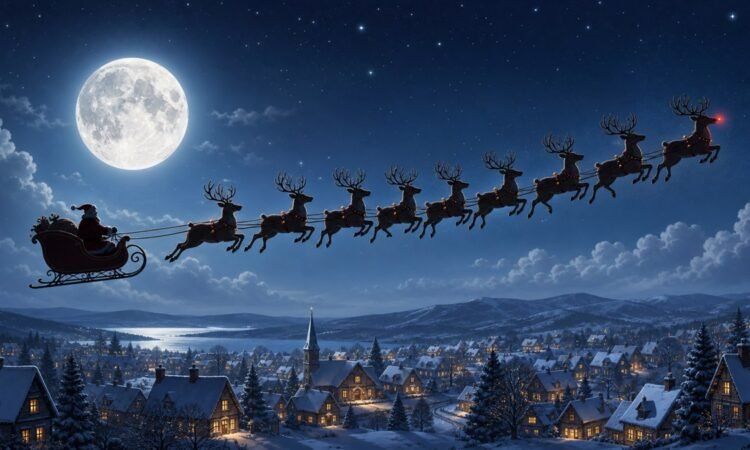
Santa does not have a standard set of 12 named reindeer in the best-known tradition. The canonical list begins with eight names from the 1823 poem commonly called “A Visit from St. Nicholas”: Dasher, Dancer, Prancer, Vixen, Comet, Cupid, Donner and Blitzen. Rudolph was created later and is usually added as the ninth.
Lists of 10, 11 or 12 usually combine characters from later books, films or local retellings. Those additions are not one universal order. If a quiz asks for “the 12 reindeer,” check which story or worksheet it uses before inventing three extra names.
The familiar order of Santa’s reindeer
- Dasher
- Dancer
- Prancer
- Vixen
- Comet
- Cupid
- Donner
- Blitzen
- Rudolph, when the later character is included
The first eight appear in the order popularized by the nineteenth-century poem. Rudolph normally leads the team in modern retellings, although his name comes last when people recite the historical list because he was added later.
Why people search for 12 names
Holiday traditions are retold through songs, television specials, children’s books, advertising and school activities. A later production may give names to relatives, apprentices or additional team members. Search snippets often merge those fictional continuities, producing a “12 reindeer” list without identifying its source.
That is different from the core literary history. The Library of Congress account of Rudolph explains that Robert L. May created the red-nosed character for Montgomery Ward in 1939. The famous song followed later. Rudolph was therefore not one of the eight in the 1823 poem.
Donner, Donder, Dunder and Blitzen
The last two names have changed spelling across versions. Early printings used forms such as Dunder and Blixem; Donder and Blitzen also appeared, while Donner and Blitzen became the common modern pair. The variation reflects editing and the Dutch- and German-influenced words associated with thunder and lightning.
A spelling difference does not create an extra reindeer. “Donder” and “Donner” are variants of the same traditional name, not two separate team members. This is one reason poorly compiled lists can reach an incorrect total.
Where Rudolph belongs in the order
There is no historically fixed harness diagram in which every named reindeer occupies a permanent left or right position. The poem gives a recitation order, not a technical formation. In the Rudolph story, his bright nose makes him the lead reindeer during difficult visibility. So two answers can both make sense:
- Historical name order: the eight traditional names, followed by Rudolph as the later addition.
- Flight formation: Rudolph at the front, with the original team behind him.
For children’s holiday activities, DeepTechy’s Christmas coloring pages collection provides a related seasonal resource. The school holiday activity guide also offers ideas that do not depend on memorizing disputed extra names.
How to answer a worksheet accurately
If the source says “name the reindeer,” give the eight canonical names and add Rudolph with a note. If it explicitly says 12, look for a word bank, illustration, film title or passage on the page. The three extra names must come from that source. Without it, the accurate response is that no universal traditional list contains 12.
This approach matters because a confident-looking list can still combine unrelated stories. Good source reading means matching the answer to the text being studied, not filling a numerical gap from memory.
A simple memory pattern
Learn the eight in four pairs: Dasher and Dancer; Prancer and Vixen; Comet and Cupid; Donner and Blitzen. Then remember Rudolph as the later red-nosed leader. The pair pattern keeps the poem’s familiar sequence and avoids counting spelling variants twice.
Bottom line
The widely recognized answer is eight original reindeer, or nine when Rudolph is included. There is no source-independent canonical list of 12. If a school question expects 12, it is missing the particular story or word bank that supplies the additional characters.
What “canonical” means in this question
Canonical does not mean that every modern Christmas story must use the same cast. It means the names can be traced to the source that established the familiar tradition. For Santa’s team, the starting point is the poem first published in 1823, which calls eight reindeer in sequence. Rudolph has a separate, documented origin in Robert L. May’s 1939 story. Later productions are free to add characters, but their additions belong to those particular fictional worlds.
This source distinction solves the apparent counting problem. A historical question has an eight-name answer. A modern popular-culture question commonly has nine. A worksheet demanding twelve needs its own passage, film or word bank. Without that context, supplying three names from unrelated adaptations would look complete while being less accurate.
Original group, later addition and adaptation-only names
| Group | Count | How to use it |
|---|---|---|
| Names called in the 1823 poem | Eight | Use for the traditional literary list |
| Traditional eight plus Rudolph | Nine | Use for the familiar modern list, with a note that Rudolph came later |
| Characters added by a film, book or worksheet | Varies | Name them only when that source is identified |
Some adaptations feature relatives or young reindeer, and some online lists count spelling variants as different animals. Neither practice creates a universal set of twelve. The title of the adaptation is part of the answer whenever extra names are involved.
How the poem’s recitation order differs from sleigh position
The order Dasher, Dancer, Prancer, Vixen, Comet, Cupid, Donner and Blitzen is a spoken sequence. It is not a map assigning permanent left and right places. Illustrators and filmmakers arrange the team differently for the needs of a scene. Rudolph’s usual position at the front is a story role based on guiding the sleigh; it does not rewrite the earlier recitation.
If a question asks “in order,” first decide which kind of order it means. For name order, recite the poem’s sequence and add Rudolph ninth if the modern list is intended. For harness order, cite the specific illustration or production because there is no single formation shared by all versions.
Why the last two spellings vary
The poem passed through printings and editorial revisions, so the final pair appears in several forms. Dunder and Blixem, Donder and Blitzen, and Donner and Blitzen reflect that publication history. Modern English lists most often use Donner and Blitzen. Treating Donder and Donner as two separate reindeer is like counting two spellings of the same character twice.
For a classroom answer, follow the spelling used in the assigned edition if it is visible. If no edition is supplied, use the familiar modern spellings and briefly acknowledge the variants. That demonstrates source awareness without turning a simple list into a false twelve-name roster.
A teacher-friendly way to explain the answer
A concise response can say: “The traditional poem names eight reindeer in this order: Dasher, Dancer, Prancer, Vixen, Comet, Cupid, Donner and Blitzen. Rudolph was introduced later and is usually counted ninth. There is no universal traditional list of twelve, so three more names would have to come from the worksheet’s specific story.”
This answer gives the learner something usable, corrects the faulty premise politely and points to the missing evidence. It also avoids presenting fan-created or adaptation-specific characters as folklore facts.
How to check an unfamiliar twelve-name list
Look for a citation before accepting the extra names. A reliable list should identify the book, film, television special or classroom passage from which they come. Check whether it counts Rudolph, whether it treats Donder and Donner as variants, and whether it mixes Santa’s team with relatives or trainees. If the page provides no source, its number may have been copied from the wording of the query rather than from a tradition.
For research, compare publication dates. The eight-name poem predates Rudolph by more than a century, so a source that places Rudolph in the 1823 text is conflating two stages of the story. A later adaptation can still be enjoyable and internally consistent; it simply should not be presented as the origin of the traditional names.
Plural grammar: reindeer, not reindeers
The usual plural of reindeer is reindeer, as in “twelve reindeer.” The form reindeers can appear when discussing distinct types or in informal usage, but it is not the standard choice for Santa’s animals. Correcting the noun does not change the factual answer: the core list contains eight, or nine with Rudolph.
Frequently asked questions
What are Santa’s eight original reindeer?
Dasher, Dancer, Prancer, Vixen, Comet, Cupid, Donner and Blitzen.
Is Rudolph the ninth reindeer?
In popular modern tradition, yes. Historically, Rudolph was created in 1939, more than a century after the original eight-name poem.
Are there officially 12 reindeer?
No universal literary or folklore list establishes 12. A 12-name answer belongs to a specific later adaptation.
Is Donder different from Donner?
No. They are spelling variants used in different editions for the same reindeer.
Does Rudolph come first or last?
He leads in the story’s flight formation but is often listed ninth when names are presented historically.
Why are the names always in that order?
The familiar sequence follows the order in which the eight are called in the poem and repeated in later popular culture.