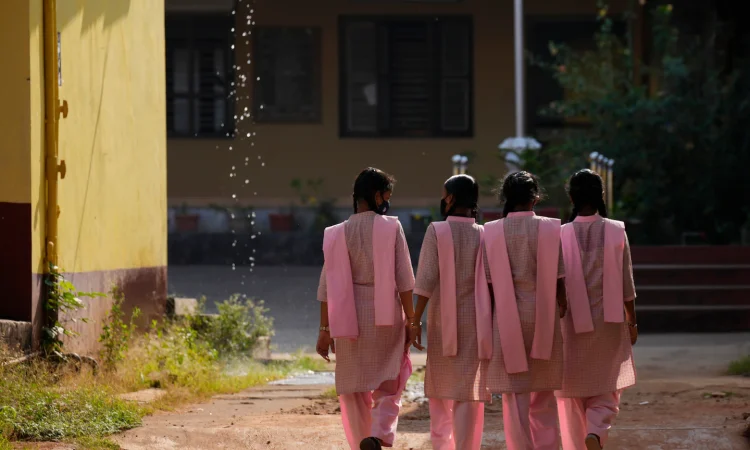
The dispute began in January when a government-run school in Karnataka’s Udupi district barred students wearing hijabs from entering classrooms, triggering protests by Muslims who said they were being deprived of their fundamental rights to education and religion. That led to counterprotests by Hindu students wearing saffron shawls, a color closely associated with that religion and favored by Hindu nationalists.
The court in its ruling said the state government had the power to prescribe uniform guidelines for students as a “reasonable restriction on fundamental rights.”
The ruling came at a time when violence and hate speech against Muslims have increased under Prime Minister Narendra Modi’s governing Hindu nationalist party, which also governs Karnataka state. Over the last few weeks, the issue has become a flashpoint for the battle over the rights of Muslims, who fear they are being shunted aside as a minority in India and see hijab bans as a worrying escalation of Hindu nationalism under Modi’s government.
Some rights activists have voiced concerns that the ban could increase Islamophobia.
“No one can understand our anxiousness about what is to follow,” Afreen Fatima, a New Delhi-based student activist, wrote on Twitter. “The court’s Hijab ban is a great injustice and a very worrying precedence. The scale of its repercussion is going to be brutal and inhuman.”
Karnataka’s education minister B. C. Nagesh told reporters that female Muslim students who were protesting against the ban must respect the court’s verdict and return to classes. He said his government will try to win the hearts of “misguided” students and “bring them in mainstream of education.”
Some Muslim politicians called the verdict disappointing.
“I hope this judgement will not be used to legitimize harassment of hijab-wearing women,” said Asaduddin Owaisi, a member of the Indian parliament.
Ahead of the verdict, the Karnataka government banned large gatherings for a week in state capital Bengaluru “to maintain public peace and order” and declared a holiday Tuesday in schools and colleges in Udupi.
The hijab is worn by many Muslim women to maintain modesty or as a religious symbol, often seen as not just a bit of clothing but something mandated by their faith.
Hijab restrictions have surfaced elsewhere, including France, which in 2004 banned them in schools. But in India, where Muslims make up 14% of the country’s 1.4 billion people, the hijab has historically been neither prohibited nor limited in public spheres. Women donning the headscarf is common across the country, which has religious freedom enshrined in its national charter with the secular state as a cornerstone.