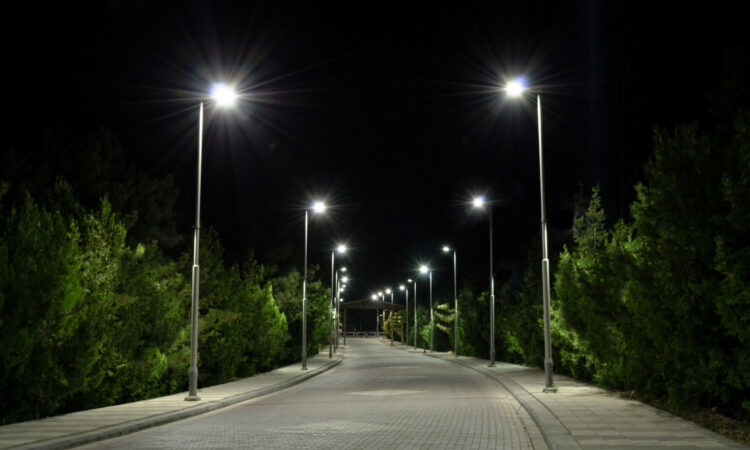
Did you know that up to one-third of the energy used by street lights is wasted? Artificial lighting has many benefits, but it also places a significant strain on power grids and local environments. The glow from street lights can alter the behavior of nearby animals, disrupt natural cycles and even interfere with airplane pilots. Unfortunately, most traditional outdoor lighting is not very energy-efficient.
Many modern street lamps have high-pressure sodium (HPS) bulbs that produce a yellowish color as well as infrared heat radiation that isn’t exactly useful for visibility or security purposes. Thanks to their tendency to generate lots of excess heat, HPS bulbs aren’t especially energy-efficient. In addition to the energy used by the light itself, these lamps often require an additional 20 W or more for the cooling system alone. A single street lamp might use more than 200 W just for its own operation! Even if these lights have a useful life of 10,000 hours — which is optimistic at best — they still waste nearly 80% of their output.
What are smart LED street lights?
As you can probably tell by now, one of the biggest problems with traditional outdoor lighting is that it’s not very smart. How do you upgrade the efficiency of your street lights without needing to completely replace the system? What do you do if you want to control them remotely? These are the questions that manufacturers of smart LED street lights want to answer for you. When shopping for a new street lamp, look for “smart” or “connected” models that offer remote monitoring, energy-saving features and other intelligent design elements.
Why Are LED Street Lights so Important?
LEDs have been used in indoor lighting applications since the 1960s. They are particularly useful in commercial and industrial settings, where high-intensity LEDs can be used to generate extremely powerful beams of light. However, there are many benefits to using LEDs outdoors as well. As we’ve already discussed, LEDs are extremely efficient — far more efficient than traditional incandescent bulbs, HPS street lamps or even fluorescent lights! LEDs can also be used in a variety of different shapes and sizes, allowing you to get exactly the kind of light you need for your home or business.
What Are the Advantages of LED Street Lights?
The advantages of LED street lights are numerous and they come with a number of advantages over conventional street lights. These advantages make them ideal for usage in different places, including residential areas, commercial hubs, and even industrial complexes. In this article, we will look at some of the benefits of LED lighting and why they are becoming so popular.
Displaying Brightness Continuously
LED lights are able to emit bright light continuously as they are not dependent on therrors. This means that they do not have different brightness levels as compared to incandescent or halogen street lights. Instead, they are able to emit a single level of brightness regardless of the conditions. This is appealing for numerous reasons. Firstly, it means that you will not experience changes in brightness when the weather conditions change. It also means that you can use the same brightness level no matter what time of day it is. This makes it ideal for a wide range of applications, including residential areas and commercial hubs.
Longer Lifespan
LED lights come with a longer lifespan than other types of street lights. While incandescent and halogen lamps last for about 1000 hours, LED lamps can last from 10,000 to 50,000 hours. This means that you will have to replace the LED lamps for up to 10 years before you need to change the other types. This makes them ideal for commercial and industrial applications, where there will be heavy use. There are also different types of LED lamps available that come with different lifespans. This means that you can choose the one that suits your needs. This is particularly important when it comes to residential areas, where there is less use of the street lights.
Environment-Friendly
LED lights are environment-friendly as they do not contain mercury. This is unlike incandescent lamps, where mercury is a key component. Halogen lamps also contain small amounts of mercury. As mercury is a highly toxic substance, it can pose a risk to people’s health as well as the environment. While incandescent and halogen lamps are energy efficient, they also lead to an increase in carbon dioxide emission. This is due to their high energy consumption. LED lights, on the other hand, are energy efficient as well as environment-friendly. This is due to their low power consumption, which makes them ideal for residential areas. They also do not lead to an increase in carbon dioxide emission even though they consume less power than other street lights.
Safer for Humans and Environment
LED lights are safe for both humans and the environment. This is because they do not contain toxic substances. As LED lights are environment-friendly, this also means that they do not lead to carbon dioxide emission. This is unlike incandescent and halogen lamps, where carbon dioxide is emitted due to the high energy consumption. This makes LED lights ideal for residential areas where they are used for security purposes such as pathway lights.
Lower Upkeep Costs
LED lights are more expensive than other types of lights when they are first bought. However, they lead to lower upkeep costs. This is because they do not require frequent replacement, unlike halogen and incandescent lights. This makes them ideal for residential areas and other places where there is low use of the lights. Exactly how much the upkeep costs are reduced will depend on the type of LED lights you choose. You can find out by comparing the maintenance costs of different LED lights.
No Dark Spots
The brightness of the lights emitted by LED lights is consistent. This means that there are no dark spots, unlike incandescent and halogen lights. This makes them ideal for residential areas, where people need even lighting. This is particularly important for places such as near the pathway, where there is a high chance of someone stepping on a dark spot accidentally. At the same time, the brightness of the LEDs can be adjusted, making them ideal for commercial applications too.
Easy Installation and Setup
LED lights can be easily installed and set up. There are no wires or cables that need to be connected. Instead, the lights are connected with a single board. This makes them ideal for residential areas, where there are no regular power cuts. In comparison, incandescent and halogen lights need to be connected with wires and cables. This makes them less ideal for residential areas, especially when there are kids around.
Better Visibility for Drivers
LED lights are better for visibility than other types of lights. This is because they are brighter than incandescent and halogen lights. This makes them ideal for commercial areas, where there is heavy traffic. At the same time, they are not as bright as mercury vapor or sodium vapor lights, which are typically used for roadways. At the same time, this also means that the drivers will be able to see the street lights better than with other types of lights.
How Much Energy Do LED Street Lights Save?
It’s important to note that these savings don’t occur immediately. When you first replace an HPS light with an LED alternative, you might see an increase in energy use. This is because an LED light will generate significantly less heat than an HPS lamp, so you’ll need to use more lights to ensure that the same area is sufficiently illuminated. However, after a few months, the savings will become more apparent. In the long run, switching to LEDs can save you thousands of dollars in energy costs per year — especially if you combine this change with other energy-efficient practices.
How well do LED Lights Perform?
Finally, LEDs also provide attractive lighting options. You can select from a variety of different color temperatures, allowing you to choose the exact tone of light that you need for your home or business. These lights also generate a significant amount of light in the blue spectrum, providing excellent visibility for pedestrians and drivers. This is important if you live in a highly populated area and don’t have much room for landscaping around your home or business.
Conclusion
LED lights are the perfect solution for any outdoor lighting application. They provide high-quality light, have a long lifespan and are very energy-efficient. When compared to older technologies, they are a much more modern and up-to-date choice. If you want to improve the energy efficiency of your lighting system, you can’t go wrong with LEDs. These lights provide a clean, white light that is highly visible, even in outdoor settings. With so many benefits and a low upfront cost, it’s clear that LEDs are the future of outdoor lighting.