
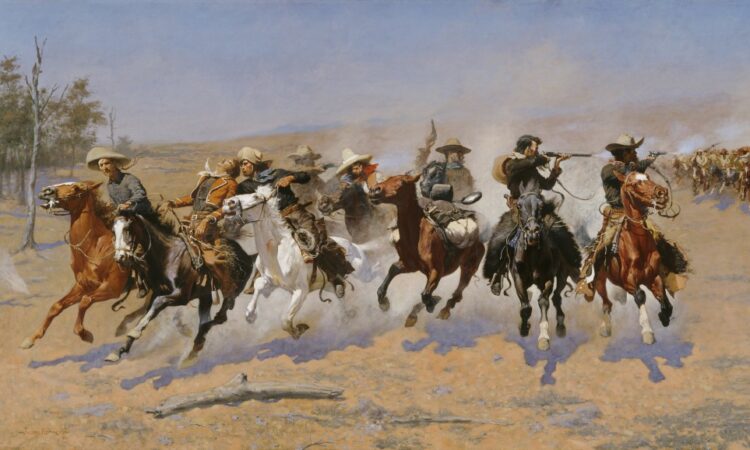
Frederic Remington (1861-1909), the American painter who is famous for his paintings and sculptures of American West cowboys and horses in the late 1800s, started his art career as a “sideline” illustrator. He provided illustrations, drawings, and sketches of the American West on a freelance basis to magazines before he decided to become professional and create paintings and sculptures.
When you discuss Frederic Remington’s paintings with art historians, you will most probably get various answers to the question of which artworks were Remington’s first paintings. The reason for the different answers is that it depends on each historian’s definition of “a painting.” For example, some art scholars will name the more formal paintings such as “A Dash of Timber” as one of his first paintings, while others regard his earlier illustrations also as “paintings.”
In this article, we’ll discuss Remington’s early works, whether they were called illustrations, sketches, or paintings, to give you an overview of the early Frederic Remington art.
Remington’s First Encounters with Art
Frederic Remington was an only child, and he was an extremely active child. He was also large and strong for his age and loved hunting, swimming, horse-riding, and camping. As an energetic, outdoors person, he was already a young boy very interested in the American West cowboys with their horses and soldiers, the cavalry, and the Native American people.
At a very early age, the artist started to make drawings and sketches of cowboys and soldiers. Because of his interest in cowboys and their lifestyle, he was sometimes called Frederic Remington the Cowboy.

Frederic Remington – The Cowboy
He was not a good student at school, but he enjoyed drawing caricatures and silhouettes of his classmates. At that stage of his life, he considered art only a sideline. Instead, Remington wanted to become a journalist.
Although he didn’t foresee a full-time career in the arts at that stage of his life, he attended art school at Yale University. He was, however, not impressed with the training classes where he had to draw from casts and still-life objects. He was much more interested in action drawing, and his very first published illustration was a cartoon of a bandaged football player. The illustration was published in the Yale student newspaper.
Remington’s Journeys as Journalist and Sideline Artist
Remington made 16 trips to the American West to gather information as a journalist, make sketches and notes, take photographs (black and white), and collect artifacts for his illustrations. His first trip to the American West was in 1881 to Montana Territory.
During his first trip, he sent a quick sketch on wrapping paper back east, and “Harper’s Weekly” later printed a re-drawing of it. This was Remington’s very first published commercial drawing. After that, Remington kept sketching, but his sketches were still cartoonish to a great extent.
In 1886, “Harper’s Weekly “sent him to Arizona on a commission as an artist-correspondent to cover the government’s war against Geronimo. He never found Geronimo, but he acquired authentic artifacts, which he later used as props in his early “formal” paintings. The most important facet of this trip was that he made many drawings and sketches for his later paintings. He also noted down the true natural colors of the West. Interestingly, art critics criticized his colors as “unnatural,” while all the colors were based on actual observation.
Due to financial and domestic circumstances, he became a silent half-owner of a saloon in Kansas City. However, he continued sketching as a sideline and made sketches of saloon inhabitants. When his wife left him and the saloon business took a knock, Remington started to sketch and paint earnestly.
Beginning of Remington’s Professional Art Career
After he had decided to try to be a full-time artist, he succeeded in selling famous Frederic Remington paintings to locals. He then realized that he could make art his real profession. So he began studies at the Art Students League of New York, and although he was there for only a few months, it bolstered his painting technique.
Because newspapers in the East were interested in the “dying West,” he kept on submitting illustrations, sketches, and other works with American West themes for publication. His first full-page cover published under his own name appeared when he was 25 years old in “Harper’s Weekly” on January 9, 1886.
In 1886 the “Harper’s Weekly” sent him to cover the 1886 Charleston earthquake. Remington expanded his commission work by doing drawings for “Outing” magazine. In his first year as a commercial artist, he earned $1,200 – almost three times a typical teacher’s salary.
He produced ink and wash drawings for commercial reproduction in black-and-white. When he started to create watercolors, he began to sell his work at art exhibitions. But he kept on creating illustrations. One of his important illustration commissions during his early years was 83 illustrations for a book by the then 29-year-old Theodore Roosevelt.
More About Remington’s Early Works
Remington’s early painting “Return of the Blackfoot War Party” (1887) was exhibited at the National Academy of Design. An art critic of the “New York Herald” commented that Remington would become one of the great American painters.
With this painting, he showed that he could handle complex compositions. An excellent example is the 1888 painting “Mule Train Crossing the Sierras.” Other early paintings include “A Dash of Timbre” (1889), “The Gendarme” (1889), “The Advance-Guard” (1890), and “The Hussar” (1893).
His early works won him a second-class medal at the Paris Exposition in 1889. The American committee also selected him to represent American paintings there.
Conclusion
During his short life, and especially his very short career as a professional artist, Frederic Remington created over 3,000 drawings and paintings. And it all started when the young Remington drew cowboys and horses and cartoon like figures of his classmates. Nowadays, art scholars agree that his magazine and other illustrations form part of his early artworks. His career as a professional artist didn’t start when he decided to turn professional, but he was already a professional artist when he was producing extraordinary illustrations.


