
Introduction
In modern manufacturing, precision, efficiency, and flexibility are crucial for producing complex components. A 5 axis cnc machining center has transformed the industry by enabling manufacturers to create intricate parts with high accuracy. Unlike traditional 3-axis machines, which move a tool along three linear axes (X, Y, and Z), a 5 axis cnc machining center adds two rotary movements, allowing for continuous and precise cutting from multiple angles.
This article explores the features, benefits, applications, and challenges of 5-axis CNC machining centers, shedding light on why industries like aerospace, medical, and automotive increasingly rely on this technology.
What is a 5-Axis CNC Machining Center?
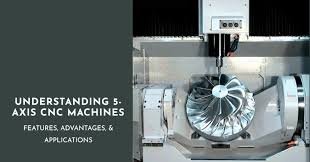
A 5 axis cnc machining center is an advanced machine tool capable of moving a cutting tool along five different axes. It consists of:
- Three Linear Axes (X, Y, Z): These move the tool in a straight-line motion.
- Two Rotational Axes (A, B, or C): These rotate the tool or workpiece to reach various angles.
- CNC Control System: A computer-controlled interface that precisely coordinates movements.
This simultaneous motion enables manufacturers to create complex geometries, deep cavities, and intricate details with fewer setups, improving production efficiency.
Types of 5-Axis CNC Machining Centers
1. Table/Table Configuration
- Both rotary movements are in the table.
- Best for small and medium-sized components.
- Offers excellent flexibility and accuracy.
2. Head/Head Configuration
- Both rotational movements occur in the spindle head.
- Suitable for large and heavy workpieces that remain stationary.
- Provides higher spindle power and rigidity.
3. Head/Table Configuration
- One rotary movement is in the spindle, and the other is in the table.
- Balances flexibility and stability.
- Commonly used in a wide range of industries.
Advantages of a 5-Axis CNC Machining Center
1. Enhanced Precision and Accuracy
A 5 axis cnc machining center eliminates the need for multiple setups, reducing the chances of misalignment and human error. This results in exceptionally 5 axis cnc machining center precise and high-quality parts.
2. Ability to Machine Complex Geometries
Traditional machines struggle with intricate contours, deep cavities, and undercuts. A 5 axis cnc machining center allows for seamless multi-directional cutting, making it ideal for aerospace, automotive, and medical components.
3. Reduced Setup Time
With fewer repositioning requirements, manufacturers save significant time on fixture setups. This leads to higher productivity and lower operational costs.
4. Improved Surface Finish
By optimizing the tool’s angle and engagement with the material, 5-axis machining reduces vibrations and tool deflection, leading to smoother finishes and minimal post-processing.
5. Cost and Material Savings
Although the initial investment is high, the efficiency of a 5 axis cnc machining center reduces material waste, tool wear, and production time, making it cost-effective in the long run.
Applications of 5-Axis CNC Machining Centers
1. Aerospace Industry
Aircraft parts, including turbine blades, fuselage components, and structural frames, require extreme precision. 5-axis machining centers enable manufacturers to meet tight tolerances and lightweight design requirements.
2. Medical Sector
Surgical instruments, prosthetics, and orthopedic implants demand smooth surfaces and exact specifications. 5-axis machining ensures high accuracy and biocompatibility.
3. Automotive Manufacturing
From engine components to transmission parts, the automotive industry benefits from the high-speed and precision capabilities of 5-axis CNC machining centers.
4. Mold and Die Making
Molds and dies used in injection molding, stamping, and casting require detailed machining. 5-axis machining produces intricate mold cavities with fewer machining steps.
5. Energy Industry
Power plant components, turbines, and wind energy parts are manufactured using 5-axis CNC machining due to their complex shapes and material requirements.
Challenges in Using a 5-Axis CNC Machining Center
1. High Initial Investment
A 5 axis cnc machining center requires expensive machinery, advanced software, and skilled operators, making it a significant financial commitment.
2. Complex Programming and Setup
Unlike 3-axis machines, 5-axis CNC machining centers require advanced CAD/CAM programming to generate complex tool paths. Operators must be proficient in multi-axis motion control.
3. Machine Maintenance and Calibration
Due to the additional moving parts, regular calibration and maintenance are essential to ensure long-term accuracy and reliability.
4. Need for Skilled Operators
Operating a 5 axis cnc machining center demands expertise in multi-axis programming, machine kinematics, and toolpath optimization. Proper training is crucial.
Comparing 5-Axis CNC Machining with Other Methods
| Feature | 5-Axis CNC Machining | 3+2-Axis Machining | Traditional 3-Axis Machining |
|---|---|---|---|
| Tool Movement | Continuous along five axes | Indexed rotation with three axes | Fixed X, Y, Z movement |
| Precision | Extremely high | Moderate | Limited |
| Complexity Handling | Excellent | Good | Low |
| Surface Finish | Superior | Good | Requires post-processing |
| Setup Time | Minimal | Higher than 5-axis | Very high |
| Programming Complexity | High | Moderate | Low |
| Cost | Expensive | Moderate | Low |
How to Select the Right 5-Axis CNC Machining Center
1. Assess Workpiece Complexity
If your parts involve intricate geometries, tight tolerances, or deep cavities, a 5 axis cnc machining center is the best option.
2. Choose the Right Configuration
- Table/Table Configuration: Best for small components.
- Head/Head Configuration: Ideal for large, heavy workpieces.
- Head/Table Configuration: Offers a balance of flexibility and stability.
3. Invest in Advanced Software
Choose high-quality CAD/CAM software that supports real-time toolpath generation, collision detection, and adaptive control.
4. Train Skilled Operators
Ensure your workforce has proper training in programming, setup, and troubleshooting to maximize machine efficiency.
The Future of 5-Axis CNC Machining Centers
With advancements in artificial intelligence, real-time adaptive machining, and automation, the role of 5-axis CNC machining centers will expand further.
Hybrid manufacturing, which integrates 5-axis machining with additive manufacturing (3D printing), is expected to revolutionize precision manufacturing, enabling faster prototyping and reduced material waste.
Conclusion
A 5 axis cnc machining center represents the pinnacle of modern manufacturing technology, providing unparalleled precision, efficiency, and flexibility. While the initial investment is high, the long-term benefits in terms of productivity, material savings, and reduced setup times make it a worthwhile choice for industries requiring high-quality, complex components.
As the technology evolves, 5-axis CNC machining centers will continue to shape the future of aerospace, medical, automotive, and industrial manufacturing, driving innovation and efficiency across multiple sectors.


