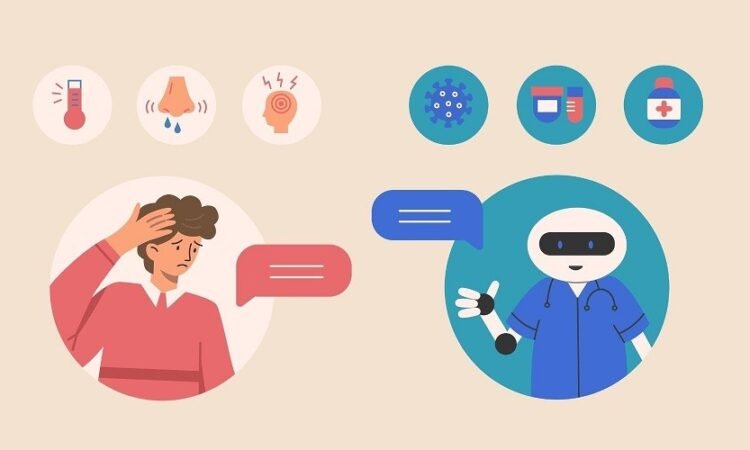
Many critical use cases that have an influence on patients as well as caregivers are being powered by conversational Artificial Intelligence. For a more straightforward explanation, you may automate discussions with consumers by deploying Conversational Chatbot and Voice bot in channels that are directly exposed to customers. In most cases, corporations automate interactions that are repetitious in order to free up employees to focus on more important responsibilities, like establishing connections, creating sales prospects, and concluding agreements.
Artificial Intelligence (AI) Powered Chabot’s
Chatbots that are driven by Artificial Intelligence (AI) have the potential to significantly expand access to mental health handlings that are both inexpensive and effective. This can accomplished by complementing the expertise of therapists. Because to their availability around the clock and the fact which can be accessed via a mobile phone, users are able to seek assistance whenever and wherever they need it, therefore overcoming both financial and logistical obstacles. Conversational AI consulting in the field of psychology have the potential to bring about substantial advancements in mental health care services. Yet, they are not without their share of ethical and technological hurdles.
The provision of insufficient or damaging help, the exploitation of vulnerable individuals, and the possible production of biased advice as a result of algorithmic bias are some of the primary problems. On the other hand, individuals who use chatbots may not necessarily have a clear understanding of the landscape of the interaction they come with these technologies.
Benefits of Conversational AI in Treating Mental Health
1. In the Spreading of Information
Misinformation and fear are the only things that spread faster than diseases during a healthcare crisis, and the COVID-19 pandemic served to underline a fact that we have always understood but sometimes forget: they are the only things that spread faster than infections. The dissemination of faulty or misleading information about health or disease-related concerns, however, may be harmful to both people and communities even in the most ordinary of situations. It is either because of this that they are unable to make the appropriate choices or because it actively pushes them to make the incorrect choices.
An AI Assistant can offer responses to frequently asked questions and inquiries which are related with a certain illness, health condition, or pandemic. By facilitating prompt access to information that is accurate, trustworthy, and up to date, it comes with potential to grow mindfulness of a particular health-related problem or crisis. Everything is done in a way that is interesting and conversational, and it is done across a diversity of digital channels such as websites, social media, messaging apps, and several more.
2. The Scheduling of Appointments
To begin, planned appointments help limit the amount of time patients have to wait, which in turn improves patient satisfaction. Technologies that allow for the scheduling and administration of appointments are becoming more popular in modern healthcare institutions. It is not unusual, on the other hand, to come across a great number of systems that have a complicated user interface, which may be quite irritating for patients.
On the other side, conversational Artificial Intelligence makes it possible for patients to book their medical appointments in a smooth manner, as well as to postpone or cancel them. Patients get support in the form of timely appointment reminders, information on papers that they should bring (or do not need to bring), and a determination as to whether or not they would want assistance subsequently to the appointment.
3. Keep an Eye on Mental Health
Because of their packed schedules, medical professionals may find it difficult to observe the well-being and retrieval of their patients while they don’t be physically present at hospital. Chatbots and Conversational AI Voicebots, conversely, offer patients the capability to start their own health objectives and work toward achieving them. The bots give patients having essential knowledge on certain tasks, so guiding them.
4. Get Familiar with the Symptom
It is possible to get information on a wide variety of subjects on the internet; nevertheless, it may be deceptive and unclear when it comes to check symptoms. Such AI bots that are driven by Artificial Intelligence, on the other hand, are able to carry out a step-by-step diagnostic and hold discussions with patients. After gaining an understanding of the patient’s situation, they proceed to ask a series of questions in order to determine the next move to take.
5. Providing Care after Therapy
The use of these bots may be beneficial even after management has been completed, since patients may want post-treatment retrieval session. As an example, they are able to remind patients of important tasks that they still require to go through after they have recovered.
6. Obtainability and Gratification
Artificial Intelligence that can engage in conversation gives patients immediate access to information and assistance. The days of having to wait for a long time and dealing with those annoying automatic menus are over. Customers are able to get instant replies to their inquiries when using chatbots powered by Artificial Intelligence, which improves their entire experience. The accessibility of this information not only helps save time but also adds to the happiness of the consumer.
7. Increased Participation from Customers
Conversational AI allows for patients to participate in meaningful discussions that are continuous. The ability to keep clients informed regarding goods, services, and discounts is something that hospitals could do via the use of individualized interaction and proactive engagement. This ongoing participation helps to cultivate a feeling of connectedness and commitment.
8. Psychotherapy Chatbots
Therapy chatbots are conversational chatbots which is driven by Artificial Intelligence and are aimed to assist persons who are coping with issues related to their mental health. It is possible to include them into one’s website or mobile application in order to properly engage with patients and give support to them.
The Final Steps
A person’s well-being is being negatively impacted by the stressful work environment, which is contributing to the increasing prevalence of mental health problems in today’s society. Despite the fact that businesses are taking steps to reduce stress, therapeutic chatbots have the potential to be quite useful in alleviating the mental health crisis and giving patients with the necessary assistance.
The Conversational AI Consulting have the potential to open up new levels of possibilities, which will make it simpler for patients in this situation to find healthcare. The cost of chatbots is quite low, making them an attractive investment opportunity for medical practitioners and other professions that provide mental health services.