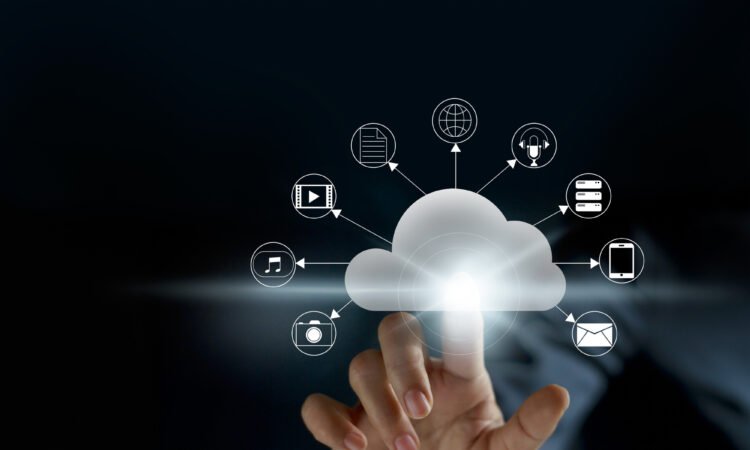
Cloud computing refers to the delivery of on-demand computing resources. It requires no active management and primarily includes storage and processing power applications. With the help of a cloud-based infrastructure model, you don’t need to opt for additional subscriptions or licenses.
Due to cloud computing solutions, you can request additional customization, backup controls, and upgrades. Conversely, the On-Premise software is deployed and maintained in-house at a physical office. It runs under the company’s supervision, while the ERP systems and data remain under the organization’s control.
But how do you decide which technology suits your company?
To make a meaningful comparison, you need to go through deep insights.
Let’s look at the following:
Deployment:
- On-Premises: In an on-premise environment, resources are deployed in-house within the IT infrastructure as enterprises are responsible for maintaining various solutions and their related processes.
- Cloud: As we know, there are different types of cloud computing: public, private, or hybrid. In a public cloud computing environment, resources get hosted on the premises of software.
Control:
- On-Premises: In an on-premises environment, organizations retain all their data, which comes in full control. Companies are highly regulated industries with extra privacy concerns. They will likely hesitate to leap into a cloud environment for multiple reasons.
- Cloud: Data ownership arises simultaneously in a cloud computing environment. Data and encryption keys reside within the boundary line of a third-party service provider.
Security:
- On-Premises: Companies with more sensitive information, like government and banking industries, must maintain a certain level of security. It also supports the level of privacy that an on-premise environment provides. Despite promising cloud infrastructure, security is the prime concern of industries dealing in banking, healthcare, and others.
- Cloud: Security concerns remain the prime barrier while looking for cloud computing deployments. There have been many cloud breaches that IT departments around the world are concerned about. This ranges from employees’ personal information, like login credentials, to the loss of intellectual property.
Compliance:
- On-Premises: Most organizations operate under some form of regulatory control regardless of the industry you’re in. The most common are the Health Insurance Portability and Accountability Act (HIPAA) and the Family Educational Rights and Privacy Act (FERPA). These industries contain a large set of details.
- Cloud: Enterprises that choose a cloud computing model need to ensure the diligence of third-party providers. They should comply with all the different regular mandates. Simply, the sensitive data must be secured. The privacy of customers, partners, and employees must be ensured.
Mobility:
- On-Premises: On-premise ERP systems can be accessed remotely. They occasionally need third-party support to access solutions on a mobile device. This increases the risk of security and communication failures.
- Cloud: With cloud systems, you need an internet connection to access data. Mobility and flexibility is the biggest solution offered by cloud-enabled infrastructure.
Infrastructure Ownership and Management:
- Cloud: A third-party cloud service provider manages the entire infrastructure in the cloud. You can get easy access, such as servers, storage, and networking, over the internet. You don’t have to invest or maintain their physical hardware. Cloud services are scalable and flexible. It allows users to pay for what they use, making it cost-effective and agile.
- On-Premises: On-premises computing involves organizations owning, installing, and maintaining their entire IT infrastructure within their physical facilities. This gives them complete control over their hardware, software, and data.
Scalability and Resource Allocation:
- Cloud: Cloud services offer dynamic scalability. It allows users to scale up or down based on their needs easily. This is particularly beneficial for businesses with fluctuating workloads, as they can allocate resources on demand.
- On-Premises: On-premises infrastructure is generally less flexible in terms of scalability. Businesses need to plan and invest in hardware and capacity well in advance.
Types Of Cloud Infrastructure:
Infrastructure-as-a-Service(IaaS):
IaaS delivers fundamental computing and networking services to the consumers on demand.
Major cloud service providers like Amazon Web Services(AWS), Google Cloud, IBM Cloud, and Microsoft Azure offer IaaS with their cloud computing services.
Platform-as-a-Service (PaaS):
PaaS offers customers a complete cloud platform comprising hardware, software, and infrastructure. This platform can easily develop, run, and manage applications without additional cost.
PaaS is ready-to-use platform that can deploy applications. It uses the technologies like predictable and cost-effective pricing.
Software-as-a-Service (SaaS):
SaaS offers software access via a subscription rather than IT teams needing to buy or install them. A renowned SaaS provider Salesforce enables software access anytime, anywhere, as long as a proper internet connection exists. This offers a room for more advanced tools and capabilities, such as optimized workflows, automation, and collaboration in real-time locations.
See Also: How Cloud Computing Can Be an Enabler of Digital Transformation
Bottom Line:
Cloud and on-premise infrastructure can both be useful for your business growth. But organizations that are using cloud computing sets to adapt to new technologies so easily conversely, it’s not the case with on-premise infrastructure solutions.