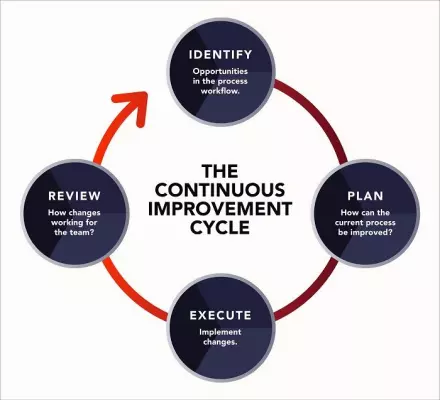
In the last five decades, the global management scenario has evolved significantly. The newer concepts of agile management, lean management, and predictive intelligence are completely disrupting the way management graduates are taught and trained in simulated business environments. If you are pursuing an Executive MBA in India, you are likely to come across very sophisticated approaches to achieving lean management. One of them is “Continuous Improvement” and this is applied to both IT and non-IT fields as part of Project Management courses in EMBA. In this article, we will discuss the various facets of project management with continuous improvement plans.
What is Project Management?
Project Management is a very old concept, maybe as old as the human race’s first food gathering mission. In industrial nomenclature, it is defined as the human led the effort to achieve a set of objectives by performing a series of activities as an individual and as a group of people, called as a team. In the business world, project management is a temporary process where the objectives of the team could change or evolve with time and effort. One of the best examples of IT based project management is “software development.” In EMBA, you would come across many managerial theories that would help you understand the nature and benefits of undergoing the industrial training with project management tools and techniques. For example, the concept of scientific management, also referred to as Taylorism is a very important one in the EMBA course. This would lead you to understand how other concepts in Project management development, such as PERT, PDCA, and Critical Path Thinking or CPM.
Why do Project Managers Focus so Much on Continuous Improvement?
Lean Management is an outcome of the post-industrial era where mechanized tools were controlled by people with extensive knowledge in planning, execution, and team management. The classical cases of lean management are mostly found in the automotive sector, where analysts attribute the success of Lean Project Management to the “Toyota Way of Thinking” – or Just in Time concepts. However, the term Lean Management for the general industry wasn’t used until the late 1980s when John Kafick used “Lean” for the first time in his editorial piece called, “Triumph of the Lean Production System.” Since then, many organizations have found success with the introduction of continuous improvement principles. This success is more to do with the way many EMBA graduates have found their foot with better corporate governance and policies to drive better outcomes at a global level, even during the recessions and pandemic periods.
What Project Managers could do with a continuous improvement plan (CIP)?
From a mechanized or scientific concept, CIP has become a cultural thing. The rise of business analytics and business intelligence are attributed to this shift in sentiment toward data driven CIP. EMBA programs that use data analytics tools to explain CIP are better suited to understanding the threats and opportunities arising in the modern world. Nevertheless, it pays to learn the techniques and the cultural aspects of executing a CIP using data analytics. Let’s understand this process. https://magazineworld.net/
Cost effective process optimization
Beta products that are produced in quicker teams with LEAN management in mind are found to be better in positioning in stiff markets. That’s how software products actually compete in the real markets. Similarly, the services industry keeps innovative with business analytics to optimize processes for go to market initiatives and secure customer interest faster than others in the competition. This is the success mantra of companies like Google, Facebook, and Amazon.
Leadership training
Without leaders, CIP is a distant dream. In the top EMBA colleges in India, trainers are focused on leadership behavior that guarantees the successful transition of the organization to meet global demands. This is successfully followed by TATA, Reliance, and other large conglomerates.
The Neo-scientific Project Management Concepts
Thanks to the rise of big data, AI, and automation in engineering and machine learning based software development, Project Management courses have received a major boost. Today, we talk of neo-scientific principles such as KANBAN, Six Sigma, and Iterative and Incremental project development, and LEAN project management. There are different standards and definitions that govern the activities, tools management, and outcomes delivered by each of these project management techniques. These are governed by ISO standards that you would have to learn in the full time EMBA course, something that makes the modern MBA programs so much more exciting. With time, the roles and functions of the people planning and controlling the project management have also changed. These specialized groups of managers are called Project Managers. They could be analysts or engineers with a solid background in Project Management. In most EMBA courses, these professionals are pursuing a diploma in Business Analytics, Operations Management, or Supply Chain Management.