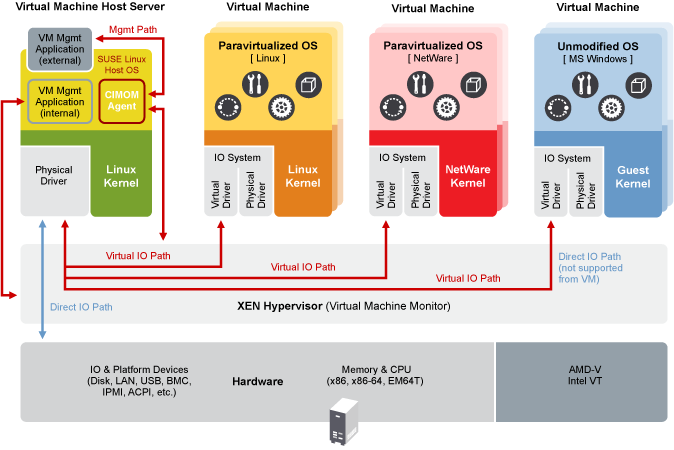
Xen hypervisor architecture
Xen’s VMM (Xen Hypervisor) is located between the operating system and the hardware, and is responsible for providing virtualized hardware resources for the operating system kernel running on the upper layer, managing and allocating these resources, and ensuring that the upper layer virtual machine (called Domain) of mutual isolation. Xen adopts a mixed mode, so a privileged domain is set to assist Xen to manage other domains and provide virtual resource services. The privileged domain is called Domain0, and the rest of the domains are called Domain U.
So Xen consists of three parts:
Xen Hypervisor: Running directly on the hardware is the access interface between the Xen guest operating system and hardware resources. By classifying guest operating systems and hardware, the Xen management system allows guest operating systems to run securely and independently on the same hardware environment.
Domain 0: A guest operating system running on top of the Xen hypervisor with direct access to hardware and privileges to manage other guest operating systems.
DomainU: A common guest operating system or business operating system running on the Xen hypervisor, cannot directly access hardware resources (such as memory, hard disk, etc.), but can exist independently and in parallel.
XenServer Architecture
XenServer is a complete server virtualization platform from Citrix. The XenServer package contains all the functionality needed to create and manage deployments of x86 machines running on Xen, an open source paravirtualized hypervisor with near-native performance. The way XenServer works is by extracting elements (such as hard drives, resources, and ports) from a physical machine and assigning them to virtual machines running on the physical machine.
XenServer includes:
Xen Hypervisor: This hypervisor is the underlying abstraction layer for software. This hypervisor is responsible for low-level tasks,
Such as CPU scheduling, and is responsible for memory isolation of resident VMs. This hypervisor is abstracted from the VM’s hardware. This hypervisor does not recognize network connections, external storage devices, video, etc. The Linux Foundation Xen Project community makes Xen virtual
The hypervisor is developed and maintained as free software, licensed under the GNU General Public License. The latest XenServer 6.5 uses the Xen hypervisor v4.4.1 control domain: also known as “Domain0” or “dom0”, the control domain is a secure privileged Linux VM (based on the CentOSv5.10 distribution) running the XenServer management toolstack. In addition to providing XenServer management capabilities, the control domain runs the driver stack and provides user-created virtual machine (VM) access to physical devices. Domain 0 is a customized version of a 32-bit Linux operating system before XenServer 6.2. In the latest XenServer6.5, Domain 0 has been upgraded to a 64-bit Linux operating system version. The previous 32-bit Domain 0 had limited memory (up to 4GB memory space), resulting in bottlenecks in the processing of the VM and the control of the internal cache, but after upgrading to 64-bit, there will be no such problems.
Management toolstack: Also known as xapi, this software toolstack controls VM lifecycle operations, host and VM networking
connectivity, VM storage, user authentication, and allows management of XenServer resource pools. xapi provides a publicly documented XenAPI management interface for use by all tools for managing VMs and resource pools.
VM Virtual machine for installing popular operating systems as VMs. That is, Domain U in Xen.
Today, our XenServer has been open sourced, so what is its positioning? In the field of server virtualization, XenServer has lagged far behind VMware and Hyper-v, and its market share has also declined rapidly. As defined by the XenServer.Org community and Citrix:
- XenServer continues to be rooted in the field of server virtualization, providing people with open-source, inexpensive and stable server virtualization products;
- Host the main underlying hosting hypervisor platform of Citrix’s heavyweight products XenApp and XenDesktop, tightly integrating some key features and best practices;
- Provide the underlying hypervisor platform for Citrix’s application delivery product NetScaler SDX;
- Provides the underlying hypervisor platform for cloud computing platforms CloudStack, OpenStack and SoftLayer’s CloudLayer.
Learn more about Xenserver backup and recovery.