
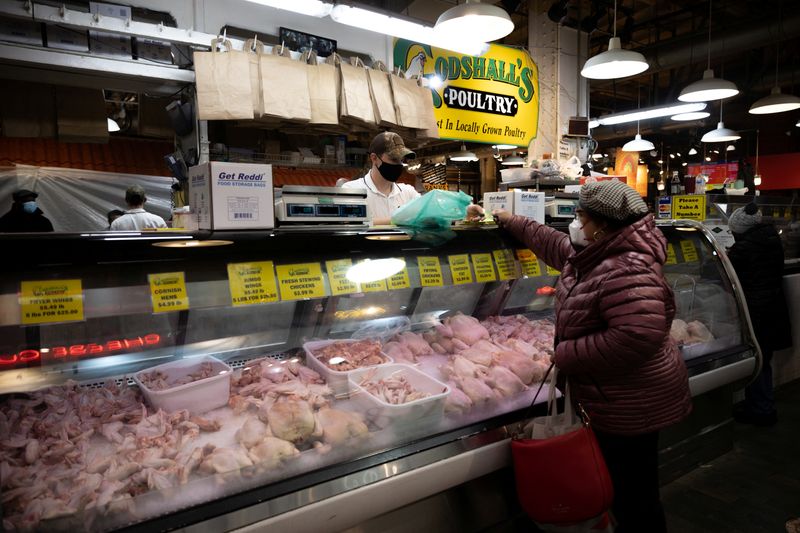
 © Reuters. FILE PHOTO: A customer shops at a poultry shop at Reading Terminal Market after the inflation rate hit a 40-year high in January, in Philadelphia, Pennsylvania, U.S., February 19, 2022. REUTERS/Hannah Beier
WASHINGTON (Reuters) – U.S. producer prices rose solidly in February, and further gains are likely amid higher prices of and other commodities following Russia’s war against Ukraine.
The producer price index for final demand increased 0.8% after accelerating 1.2% in January, the Labor Department said on Tuesday. In the 12 months through February, the PPI climbed 10% after a similar gain in January.
Economists polled by Reuters had forecast the PPI gaining 0.9% and increasing 10.0% year-on-year. The data does not capture the surge in prices of oil and other commodities, like wheat, following Russia’s invasion of Ukraine on Feb. 24.
Inflation by all measures has way exceeded the Federal Reserve’s 2% target. The U.S. central bank is expected to start raising interest rates on Wednesday. Economists are forecasting as many as seven rate hikes this year.
Crude oil prices shot up more than 30%, with global benchmark hitting a high at $139 a barrel, the highest since 2008, before easing to trade below $100 a barrel on Tuesday.
Despite the pullback in oil prices, inflation is likely to remain hot as a resurgence in COVID-19 infections in China, a major source of raw materials for U.S. factories, puts more pressure on supply chains.
“U.S. inflation will accelerate through the first half of this year and will almost certainly push higher still in the third quarter if not the fourth,” said Chris Low, chief economist at FHN Financial in New York.
Inflation was already a problem before the Russia-Ukraine war. A shift in spending to goods from services during the COVID-19 pandemic and trillions of dollars in relief from the government unleashed strong demand, which ran against capacity constraints as the spread of the coronavirus pushed millions of workers out of the labor market, making it harder to move raw materials to factories and finished goods to consumers.
The government last week reported an acceleration in consumer prices in February, with the annual inflation rate posting its largest increase in 40 years.
High inflation, mostly in the form of more expensive gasoline, has prompted economists to trim their economic growth estimates for this year. So far, a recession is not anticipated as households accumulated massive savings during the pandemic.
Excluding the volatile food, energy and trade services components, producer prices climbed 0.2% in February. The so-called core PPI increased 0.8% in January.
In the 12 months through February, the core PPI rose 6.6% after gaining 6.8% in January.
Fusion Media or anyone involved with Fusion Media will not accept any liability for loss or damage as a result of reliance on the information including data, quotes, charts and buy/sell signals contained within this website. Please be fully informed regarding the risks and costs associated with trading the financial markets, it is one of the riskiest investment forms possible.